
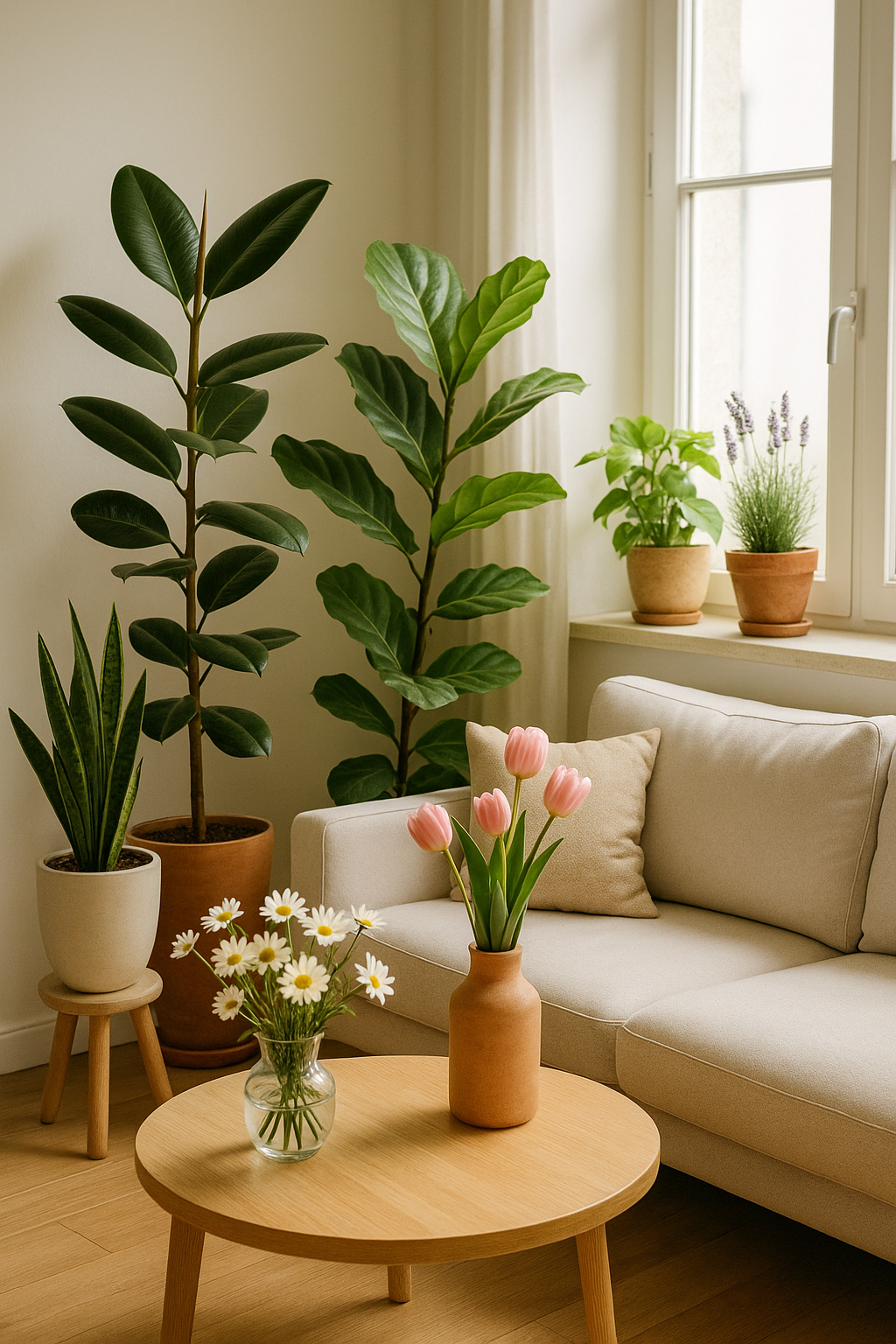
Finding Beauty in Balance
There is a delicate art to placing plants within an interior — a kind of choreography that invites life without overwhelming form. In a world that celebrates abundance, restraint becomes its own elegance. To decorate with plants is not merely to fill space, but to awaken it. The goal is never to overwhelm, but to whisper: here is life, breathing quietly in a corner, reaching gently toward the light.
This article explores how to integrate plants into your space with grace and intention. We’re not aiming for a jungle, nor a greenhouse, but rather a living room that lives — slowly, thoughtfully, and beautifully.
The Aesthetic of Restraint: Why Less Is Often More
In interiors, as in poetry, silence between the lines is what gives meaning. An overfilled shelf or a window cluttered with foliage can obscure the very beauty we hoped to reveal. Plants are living sculptures, and like all artwork, they require negative space to be fully seen and appreciated.
When thoughtfully arranged, even a single plant can anchor a room. The placement of three, if balanced, can define its rhythm. It is not about how many plants you have, but about how they breathe within your home.
Start with Structure: The Role of Focal Plants
Every arrangement begins with a lead — a visual anchor that sets the tone for everything else. These are often bold, architectural plants with a strong silhouette. Think:
Fiddle-leaf fig: Tall, sculptural, and commanding
Monstera deliciosa: Wide, split leaves that suggest rhythm and openness
Bird of paradise: Strong vertical lines and exotic presence
Snake plant (Sansevieria): Clean and minimal with graphic edges
These plants should stand alone or with minimal companions. Give them space. Let them interact with light, wall texture, and nearby furniture. They are not decorations — they are residents.
Accent Plants: The Supporting Cast
Around your focal plants, add supporting elements with lighter visual weight. These should not compete, but rather complement.
Spider plants: Delicate and trailing
Fern varieties: Soft, airy, and textured
Pothos: Elegant vines that soften corners or shelves
Peperomia or pilea: Round-leafed charm with a gentle presence
Use accent plants to lead the eye — up, across, or downward. Their task is to create rhythm, not noise.
The Rule of Odd Numbers and Negative Space
Design principles suggest that grouping plants in odd numbers (three, five, seven) is visually more dynamic than even ones. But more important than number is spacing. Between each plant, let there be silence. A clean table. A patch of empty floor. A bare window.
Without this negative space, the eye cannot rest — and beauty becomes confusion.
Try arranging plants in a triangle: one taller, one medium, one trailing. Or cluster two pots on a low stool with one wall-mounted fern above. Let each grouping feel intentional, like verses in a poem.
Light as a Guide: Placement and Purpose
Plants need light, but so do rooms. Natural illumination shapes emotion, and your placement of plants should respond to that interplay.
Bright south-facing rooms can accommodate statement plants — palms, monsteras, fiddle-leafs — that thrive in light and return it with vibrant foliage.
North-facing spaces might prefer smaller, more shade-tolerant varieties — snake plants, ferns, or philodendrons — which don’t demand visibility, but reward presence.
Let the direction of light dictate the personality of your greenery. Place trailing vines where they catch soft backlight. Let a sculptural leaf intersect a beam of sun. These moments are not staged; they are invitations.
Shelves, Sills, and Hanging Displays
Not all plants need the floor. Shelves offer excellent opportunities for trailing or compact species. But avoid crowding. Leave books, ceramics, or open space nearby. A single pothos trailing beside a row of books is more effective than five pots in a row.
Windowsills, when curated, become altars of light and season. Arrange two or three small pots in terracotta or matte ceramic. Mix textures — the rounded leaf of a peperomia with the spikes of aloe, or a small bloom like miniature roses or African violets.
Hanging planters should add verticality, not chaos. Choose one trailing plant per hook or shelf. Let its leaves move with air and light. If you must add more, stagger heights or use differing pot shapes to guide visual rhythm.
Vessels of Calm: Choosing the Right Pot
Your choice of container is as critical as the plant it holds. Together, they form a composition. Opt for:
Neutral tones in ceramic, concrete, or matte-glazed pottery
Glass containers for rooting cuttings or minimalist effect
Terracotta for warmth and tradition
Avoid excessive pattern or shine unless the room calls for contrast. The container should enhance, not distract. It is the frame to a painting, the stem to a bloom.
Layering Without Clutter
You may layer plants across a space without cluttering it — if you follow a rhythm. Try this structure:
A tall floor plant in one corner
A trailing shelf plant above a sofa
A small tabletop vase with fresh-cut flowers
A hanging basket in the opposite window
This creates movement across dimensions — height, width, depth — and prevents the space from feeling weighed down.
The Seasonal Edit: Less Can Become More
As with fashion, interiors benefit from rotation. Not all plants must be displayed all the time. In spring, favor blooming varieties — orchids, anthuriums, lilies. In summer, embrace lush foliage. In autumn, include dried florals or seed pods. In winter, simplify — a bare branch in a tall vase can feel more alive than a dozen potted plants.
Editing is essential to refinement. Know when to let go, or when to move a plant to a quieter room. This seasonal rhythm not only protects your space from overcrowding but keeps it emotionally fresh.
Final Thought: Space to Breathe, Room to Grow
To arrange plants beautifully is to allow room — for both leaf and silence, for bloom and breath. It is not about more. It is about meaning. A home filled with greenery is a home alive — but only if the plants are placed with care, restraint, and poetry.
So step back. Observe your room as a whole. Place one stem where the light falls. Let another curl around a corner. Leave empty space around them like pauses in music.
You will find that you need fewer plants than you think — and that the space between them is where elegance lives.