
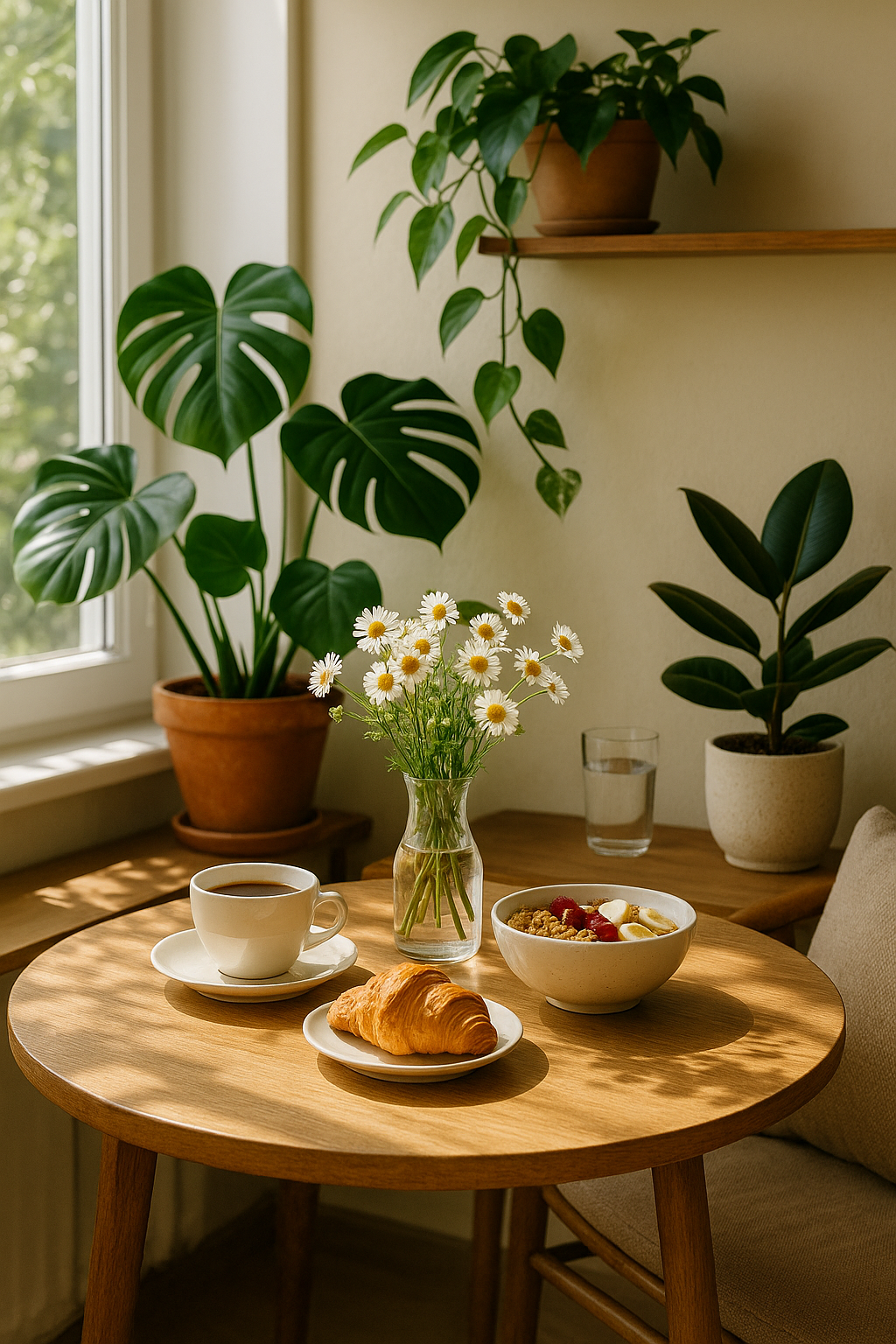
In a world marked by excess, silence becomes a rare and precious resource. Minimalist design embraces that silence — not as emptiness, but as intentional space. It is the art of choosing what matters and letting go of what does not. When nature is invited into this quiet architecture, something extraordinary happens: the stillness breathes. The room awakens, not with noise, but with life.
This is the meeting point between minimalism and nature — a conversation where each element speaks only when needed, and yet says everything.
A Philosophy of Restraint and Presence
Minimalism is often misunderstood as austerity. But at its heart, it is not about subtraction — it is about clarity. It is the decision to keep only what serves a purpose: functional, emotional, or aesthetic. Nature, when brought into this equation, aligns perfectly. A single leaf, a curved branch, or a modest flower holds more presence in a pared-down space than an entire bouquet in a cluttered room.
It is this philosophy of mindful inclusion that transforms objects into experiences. You do not simply see the plant in the corner — you feel its silhouette against morning light, its growth across weeks, its quiet companionship.
The Power of a Singular Element
In minimalist interiors, one living object can reshape the entire space. A snake plant in a sculptural ceramic pot beside a white wall. A trailing pothos over the edge of an open shelf. A single monstera leaf in a glass vase. These are not decorations. They are statements.
They remind us of slowness, resilience, and organic movement — qualities too often lost in modern routines.
Choose your natural elements with intention. Let each plant or floral accent have a reason for being — a story, a shape, a rhythm that contributes to the room’s equilibrium.
Breathing Space: Designing with Light and Air
Natural light is the minimalist’s most powerful ally. It sculpts a room without ever occupying it. When paired with greenery or subtle floral accents, light brings dynamism to simplicity. Shadows stretch across pale floors. Leaves glow against the softness of sheer curtains.
This interplay between air, plant, and light creates the feeling of space — even in the smallest apartment. It is not about volume. It is about atmosphere.
Allow your space to breathe. Resist the temptation to fill every corner. Let empty walls exist. Let negative space define what surrounds it.
Textural Contrast and the Beauty of Imperfection
Minimalist design is often associated with smooth surfaces, muted tones, and clean geometry. When nature enters this landscape, it offers a counterpoint — texture, unpredictability, and imperfection. A rough clay pot, a stem that leans to the left, a leaf marked by light. These “flaws” are not flaws at all. They are signs of life.
Integrating wood, linen, stone, and handmade ceramics enhances this connection. These materials carry the same language as the plants they hold — tactile, grounded, and unrefined in the most elegant sense.
By layering texture gently, you prevent minimalism from becoming sterile. Instead, it becomes soulful.
Purposeful Placement and Flow
In minimalist spaces, placement becomes everything. Because each object holds more weight, its position must serve both function and form.
A small bench beside a window becomes a sanctuary when accompanied by a pot of lavender. A floating shelf gains poetry when a string of pearls drapes softly over its edge. A nightstand becomes a sensory retreat with a sprig of eucalyptus in a stoneware jar.
These placements guide the eye. They create pause. They invite interaction — not in a performative way, but in a deeply human one. The room becomes navigable by instinct, not by excess.
Color as Whisper, Not Shout
Minimalist interiors thrive on neutral or softened palettes: whites, creams, grays, earth tones. Nature fits within this scheme effortlessly. The green of a plant, the blush of a single bloom, the golden core of a daisy — these natural pigments offer balance, not intrusion.
If bolder colors are desired, they should be purposeful. A single deep red orchid. A cobalt vase holding a stem of olive. When used with restraint, color becomes not a distraction, but a form of visual punctuation.
Think of it not as painting the room, but as composing it.
Embracing Change and the Seasonal Mindset
One of the gifts of working with natural elements in a minimalist setting is the invitation to change. Flowers wilt. Branches shift. Light evolves with the season. This impermanence is part of the design, not a flaw in it.
Unlike static decor, plants and florals create a rhythm. Replace peonies in the spring with dried grasses in the fall. Let lavender give way to rosemary. This seasonal rotation refreshes the space without demanding new furniture or design overhauls. Minimalism welcomes change, because it builds from essentials — not trends.
Final Thought: Stillness That Holds Life
Decorating with purpose is not an exercise in deprivation. It is an act of care — for the home, for the self, for the natural world we invite inside.
When minimalism meets nature, a room no longer feels empty. It feels essential. Every surface, every shadow, every stem becomes part of a greater whole. You do not enter the room for distraction. You enter it for restoration.