
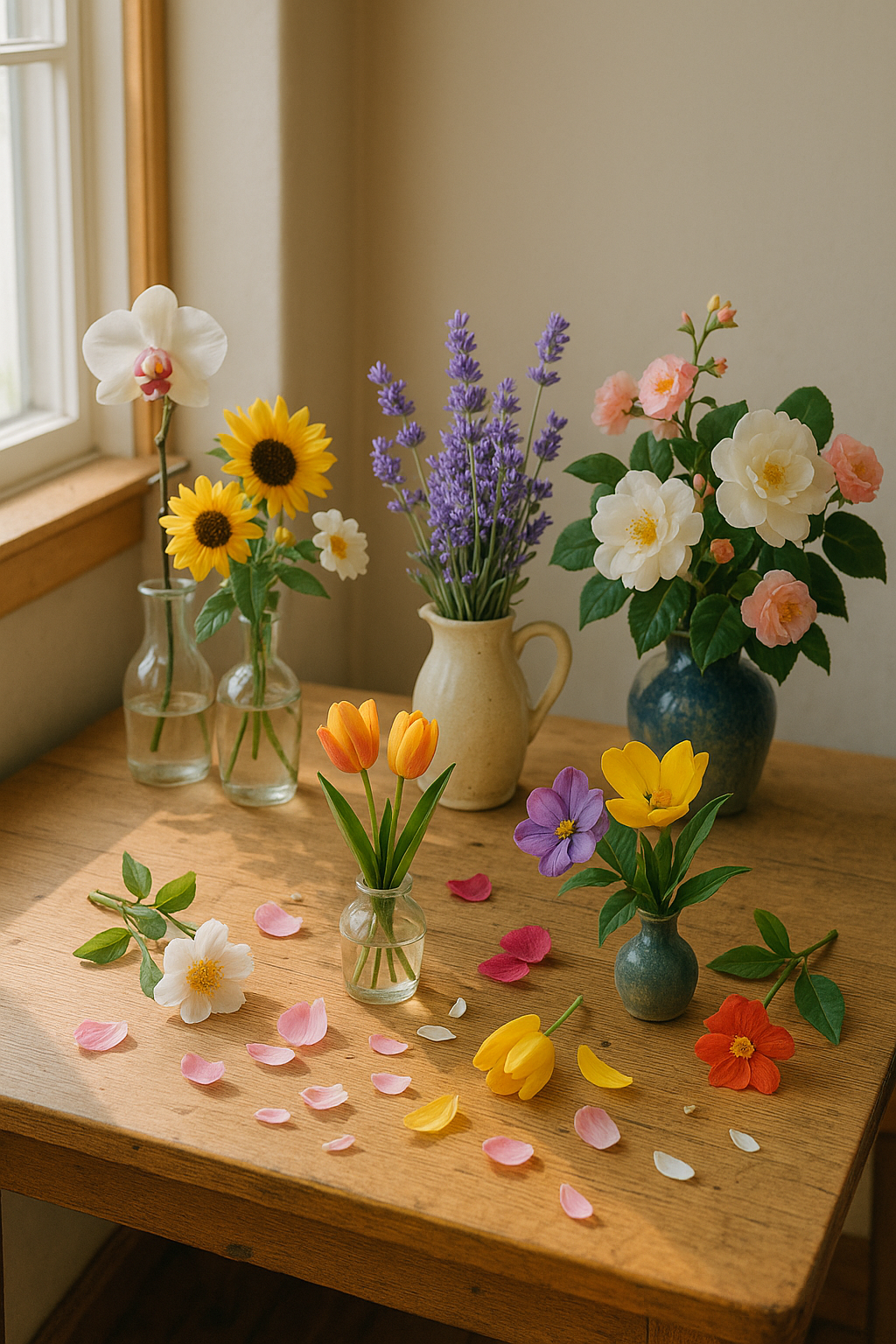
A home is not just built of beams and walls. It is constructed of memory, mood, and meaning. Within its quiet architecture, the objects we choose to surround ourselves with speak in unspoken ways. And among them, flowers speak most intimately — in a language of petals, a narrative of color, form, and fragrance that tells not only of beauty, but of the human heart.
To decorate with flowers is not simply to adorn. It is to express, to evoke, to communicate. Every bouquet tells a story. Every petal becomes a page. This is the language of florals — a form of storytelling rooted in memory and emotion, unfolding silently across living rooms, hallways, bedside tables, and kitchen shelves.
The Emotional Vocabulary of Flowers
Since ancient times, flowers have carried symbolic weight. Cultures across the globe have assigned meaning to blooms — roses for love, lilies for mourning, lavender for devotion, sunflowers for admiration. But beyond their traditional symbolism, flowers evoke personal memories. The scent of jasmine may recall a childhood garden. A spray of tulips might bring back the first apartment you called your own.
In interior design, this emotional undercurrent becomes a powerful tool. Flowers, when chosen with care, can shape the mood of a space far more deeply than paint or furniture ever could.
Choose white orchids for clarity and calm.
Select blush peonies to soften a room with romance.
Add vibrant marigolds for energy and light.
Allow cherry blossoms to lend a sense of fleeting beauty and quiet nostalgia.
Each flower offers a feeling. Each arrangement becomes a phrase. Together, they compose the emotional tone of a home.
Composing with Intention
To design a floral story within your interior, begin not with color — but with emotion. Ask yourself: what do I want this space to say?
Is it an invitation to slow down?
A tribute to joy?
A memory held close?
Once that intention is clear, begin composing. Consider not only the flowers themselves but their placement, container, and relationship with light. A cluster of dried lavender near a sunlit window will whisper differently than a single lily in a narrow hallway. Just as a writer chooses sentence structure, a floral designer selects form and rhythm.
In the living room, use floral arrangements to spark conversation or reflection. A sculptural bouquet with asymmetrical lines may become the centerpiece — both visually and emotionally.
In the bedroom, opt for softness. Allow scent to guide your choices. Let the flowers soothe and hush the air.
In transitional spaces — hallways, entryways, stair landings — tell shorter stories. A bud in a narrow glass vase. A stem on a shelf. A bloom by the mirror. These small moments accumulate into a narrative that winds through your home.
Layering with Memory
One of the most powerful aspects of floral storytelling is its connection to personal history. Beyond what a flower represents culturally, it carries individual meaning.
A kitchen filled with potted basil and rosemary may recall a grandmother’s cooking.
A windowsill of daffodils may speak of a spring morning spent in the countryside.
When curating floral decor, consider not only aesthetics, but autobiographical resonance. The language of petals becomes deeply moving when it includes your own vocabulary of memory. A home layered with these kinds of intentional gestures gains emotional depth — not just visual beauty.
The Role of Impermanence
What makes floral storytelling so compelling is its transience. Flowers do not last forever. Their beauty fades. Their presence is fleeting. And that temporariness, rather than diminishing their impact, enhances it.
Unlike a chair or a framed artwork, a floral arrangement has a life cycle. It blooms, changes, and eventually disappears. In this way, it mirrors our own stories — not fixed, but unfolding.
Welcoming this impermanence into our homes is a quiet act of acceptance. It reminds us to appreciate what is present now. To celebrate beauty even in its most fleeting form.
To refresh your arrangements weekly or seasonally is to keep the story alive — constantly evolving. Let today’s tulips give way to tomorrow’s poppies. Let the narrative shift with the weather, the light, the mood of your own days.
Containers as Punctuation
If the petals are the words, then the vases, bowls, and vessels are the punctuation. They shape the way the story is read.
Use a tall glass vase for drama — a bold exclamation.
A shallow bowl for subtlety — a quiet ellipsis.
A rough ceramic jug for nostalgia — a paragraph from the past.
Just as a writer considers spacing and rhythm, the way you place flowers matters. Let the eye pause, breathe, and move. Let one bloom stand alone for emphasis. Let another group cluster like a chorus.
Telling Stories Without Saying a Word
There is something profoundly intimate about walking into a room and sensing its unspoken language. A home that uses florals to speak is a home that communicates emotion — not in loud declarations, but in whispers.
The scent of eucalyptus along the hallway
A wild arrangement of sunflowers in the dining room
A single camellia beside a favorite book
Each detail is part of the story. A chapter. A line of poetry.
Final Thought: A Petal for the Heart
Floral design is often thought of as ornament. But when approached as storytelling, it becomes something more enduring. Something that grows not only on the table, but in the mind.
Let your flowers say what words cannot.
Let them carry feeling across rooms.
Let them speak of what matters.
In petals, you find presence. In stems, a thread of memory. In fragrance, the quiet echo of something you thought you’d forgotten.
And together, they become a language — a deeply human one — spoken not with the mouth, but with the heart.